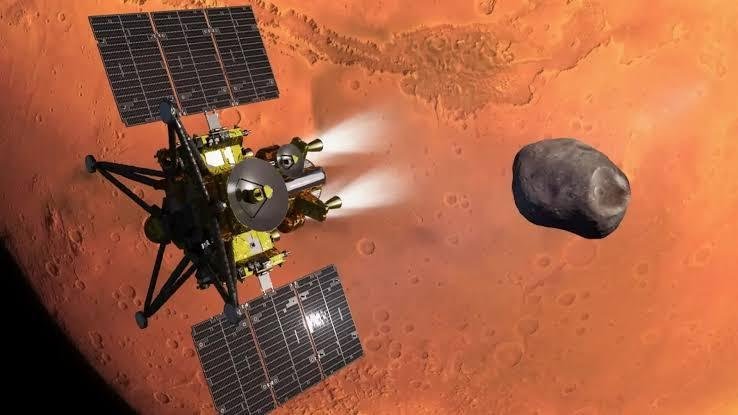
MMX Spacecraft Sets Course for Phobos to Retrieve Samples for Scientific Research
Quick Summary
Japan launched its Martian Moons eXploration (MMX) spacecraft on October 20, 2026, to investigate Phobos, the larger of Mars’ two moons. The Japan Aerospace Exploration Agency (JAXA) launched the uncrewed spacecraft aboard an H3 rocket from Tanegashima Space Center in southwestern Japan. The mission aims to collect at least 10 grams of material from Phobos and return the samples to Earth for detailed scientific analysis.
The spacecraft is expected to reach Mars in August 2027, with its return journey scheduled for 2031. Scientists hope the mission will reveal important clues about the origins of Mars’ moons and the early development of the solar system. The launch also marked the H3 rocket’s first interplanetary mission, representing an important milestone in Japan’s space exploration programme.
Introduction
Japan has launched an ambitious planetary exploration mission to collect samples from Phobos, one of Mars’ two natural moons, and bring them back to Earth for scientific examination. The Martian Moons eXploration spacecraft will study this small, irregularly shaped rocky body, helping researchers investigate its composition, formation, and relationship with the Red Planet.
Through this mission, JAXA aims to uncover valuable evidence about the origins of Mars’ moons and gain a clearer understanding of the processes that shaped the early solar system.
Japan Launches Historic Mission to Collect Phobos Samples
Japan launched its uncrewed MMX spacecraft aboard an H3 rocket before dawn on October 20, 2026, from the Tanegashima Space Center in southwestern Japan. The mission aims to achieve a significant milestone by collecting material directly from Phobos and returning it to Earth for laboratory analysis.
Unlike observations conducted remotely through telescopes and spacecraft instruments, returned samples will allow scientists to examine the moon’s physical and chemical properties in greater detail. The mission could also provide new evidence about the formation of Mars’ moons and their connection with the planet’s early history.
Phobos Characteristics Make It an Important Research Target
Phobos, the larger of Mars’ two natural moons, has an irregular shape and measures approximately 27 kilometres by 22 kilometres by 18 kilometres. It orbits around 6,000 kilometres above the Martian surface and completes approximately three orbits around Mars every day. Its unusual dimensions, close orbital distance, and rocky composition make Phobos an important target for planetary scientists investigating the origins of celestial bodies.
By studying material collected from its surface, researchers hope to understand how the moon formed and whether its composition contains clues about Mars’ early environment and the development of the solar system.
MMX Mission Aims to Return at Least 10 Grams of Phobos Material
JAXA plans to collect at least 10 grams of surface material from Phobos and transport the samples back to Earth for detailed scientific investigation. The returned material could help researchers analyse the moon’s composition, identify its constituent minerals, and investigate the processes involved in its formation.
Scientists also hope the samples will help distinguish between competing explanations for Phobos’ origins, including whether it formed from debris surrounding Mars or originated elsewhere before entering its current orbit. The mission’s findings could strengthen scientific understanding of Mars’ moons and the broader processes that shaped planetary bodies during the solar system’s early stages.
H3 Rocket Begins Its First Interplanetary Mission
The MMX launch marked the first interplanetary mission for Japan’s H3 rocket, adding an important milestone to the country’s space exploration programme. The H3 launcher experienced a major setback during its inaugural flight in 2023, when its second-stage engine failed to ignite and prevented the mission from proceeding successfully.
Since then, the rocket has completed a series of largely successful launches, supporting Japan’s efforts to strengthen its launch capabilities. By sending the MMX spacecraft towards Mars, the H3 rocket has taken on a demanding planetary exploration mission that could demonstrate its value for future interplanetary projects.
FAQs
1. What is Japan’s Martian Moons eXploration mission?
Japan’s Martian Moons eXploration (MMX) mission is a planetary research project designed to investigate Phobos, collect surface samples, and return them to Earth for detailed scientific analysis.
2. When did Japan launch its mission to collect samples from Phobos?
Japan launched the uncrewed MMX spacecraft on October 20, 2026, aboard an H3 rocket from Tanegashima Space Center in southwestern Japan.
3. When will Japan’s MMX spacecraft reach Mars?
The MMX spacecraft is expected to reach Mars in August 2027, beginning the next stage of its mission to investigate the Martian moons and collect Phobos samples.
4. How much material will Japan collect from Phobos?
The Japan Aerospace Exploration Agency aims to collect at least 10 grams of material from Phobos’ surface and return it to Earth for laboratory examination.
5. When will the Phobos samples return to Earth?
Japan’s MMX mission currently targets 2031 for the return of collected Phobos samples, which scientists will analyse to investigate the moon’s composition and origins.
Key Takeaways
- Japan launched its MMX spacecraft on October 20, 2026, to investigate Phobos and retrieve surface samples for scientific analysis.
- The H3 rocket carried the uncrewed spacecraft from Tanegashima Space Center, marking the launcher’s first interplanetary mission.
- JAXA aims to collect at least 10 grams of material from Phobos for detailed laboratory examination on Earth.
- The spacecraft is expected to reach Mars in August 2027, with the sample-return mission targeting completion in 2031.
- Scientists hope the mission will reveal clues about the origins of Mars’ moons, their composition, and the early development of the solar system.
Conclusion
Japan’s MMX mission represents an important development in planetary exploration, with its planned collection of Phobos samples offering scientists an opportunity to study Mars’ larger moon directly. The mission aims to return valuable material to Earth by 2031, supporting research into the moon’s composition, formation, and relationship with Mars.
Its findings could also improve scientific understanding of how planetary bodies developed during the solar system’s early history. Additionally, the successful launch marks a significant milestone for Japan’s H3 rocket as it undertakes its first interplanetary mission.

 Magazine
 info@luminarytimes.com
 +1-8308642693