Scientists Finally Discover Betelgeuse’s Companion Star after Decades of Astronomical Investigation
Quick Summary
Astronomers have finally confirmed the long-suspected Betelgeuse companion star through direct observations. The discovery proves that Betelgeuse belongs to a binary star system instead of existing alone.
Scientists believe this breakthrough could change previous predictions about when the famous red supergiant may explode as a supernova. Researchers also expect future observations to reveal how both stars interact and influence each other’s evolution.
Introduction
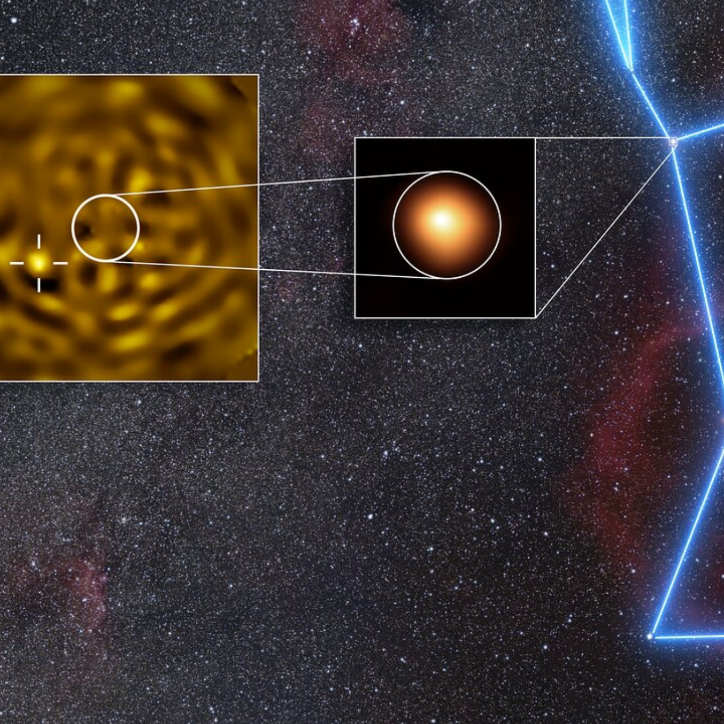
The Betelgeuse companion star has finally been confirmed after decades of scientific investigation. Astronomers captured the hidden companion using powerful telescope observations, ending a century-old search for direct evidence.
Betelgeuse remains one of the brightest and largest stars visible from Earth, making this discovery one of the most significant astronomy breakthroughs in recent years. Scientists now believe the newly confirmed companion could reshape existing theories about the giant star’s life cycle and its expected supernova explosion.
Betelgeuse Companion Star Discovery Ends a Century-Old Mystery
Astronomers had suspected for nearly 100 years that Betelgeuse might have a stellar companion. Several recent studies supported that possibility, yet researchers lacked direct confirmation. The latest observations finally captured the companion orbiting the famous red supergiant. This clear detection officially establishes Betelgeuse as part of a binary star system.
Betelgeuse carries approximately 16.5 to 19 times the Sun’s mass. Its newly confirmed companion also ranks as a massive star, holding roughly 2.6 to 3.1 solar masses. The companion measures nearly twice the Sun’s diameter and shines dozens of times brighter than our star. Both stars lie about 500 to 600 light-years away inside the Orion constellation.
Binary Star System Could Change Betelgeuse Supernova Predictions
Scientists previously estimated that Betelgeuse could explode as a supernova within the next 10,000 to 100,000 years. That prediction now carries greater uncertainty because the companion may influence Betelgeuse’s evolution. Gravitational interactions between both stars could either accelerate or delay the giant star’s final explosion.
Researchers also know that Betelgeuse regularly brightens and dims. Earlier studies linked those brightness changes to giant clouds of material expelled from the star. As the hot material cools, it forms dust that occasionally blocks part of Betelgeuse’s light. Scientists will now examine whether the companion also affects these brightness variations.
Betelgeuse Discovery Opens a New Chapter in Stellar Research
Betelgeuse ranks among the largest known stars. If it replaced the Sun, its outer surface would extend beyond Jupiter’s orbit. Despite its enormous size, the star remains only about 10 million years old because massive stars consume their fuel extremely quickly.
Astronomers expect this discovery to improve future research on massive binary stars. Continued observations may explain how companion stars influence stellar growth, mass loss, brightness changes, and supernova events. The breakthrough also highlights that even famous stars can still surprise scientists with previously hidden characteristics.
FAQs
1. What is the Betelgeuse companion star?
The Betelgeuse companion star is a newly confirmed massive star orbiting Betelgeuse. Astronomers directly observed it after decades of searching, proving that Betelgeuse belongs to a binary star system.
2. Why is the Betelgeuse companion star discovery important?
This discovery confirms a century-old scientific theory and changes how researchers understand Betelgeuse’s evolution. It also creates new questions about when the giant star could eventually explode as a supernova.
3. How far is Betelgeuse from Earth?
Betelgeuse and its companion are located about 500 to 600 light-years from Earth. Despite that great distance, Betelgeuse remains one of the brightest stars visible in the night sky.
4. Will Betelgeuse still explode as a supernova?
Scientists still expect Betelgeuse to become a supernova because it has reached the final stage of its life. However, the newly confirmed companion makes the exact explosion timeline much harder to predict.
5. Why does Betelgeuse appear brighter and dimmer over time?
Scientists believe Betelgeuse ejects large amounts of hot material into space. That material cools into dust clouds, which sometimes block part of the star’s light and cause noticeable brightness changes.
Key Takeaways
- Astronomers directly confirmed the long-suspected Betelgeuse companion star.
- Betelgeuse officially belongs to a massive binary star system.
- The companion may influence the star’s future supernova timeline.
- Both stars orbit each other about Saturn’s distance from the Sun.
- Scientists expect future observations to reveal new details about stellar evolution.
Conclusion
The confirmed Betelgeuse companion star marks a major milestone in modern astronomy. Scientists have answered one of the longest-standing questions surrounding this famous red supergiant.
The discovery also introduces fresh challenges because the companion may reshape existing supernova predictions. Continued observations will help researchers understand how both stars evolve together and how their relationship influences one of the most remarkable stars in the night sky.

 Magazine
 info@luminarytimes.com
 +1-8308642693